Why Barefoot Shoes Feel Worse in Month Two Than Month One
Quick Answer: Month one feels good because you are wearing them lightly and your feet are fresh. Month two feels worse because your mileage has crept up while your foot muscles are still mid-adaptation — the tissue is remodelling but not yet strong. It typically resolves by week 10 to 12 if you hold volume steady instead of pushing through.
Week two, you told everyone about them.
Week six, your arches ache by 3pm and you are quietly wondering whether you wasted the money.
This dip is so common it is nearly a rule, and the reason is more encouraging than it feels.
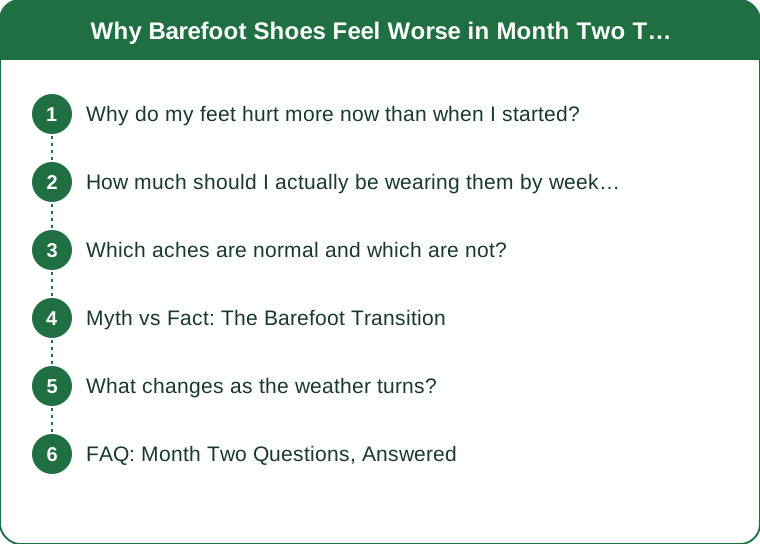
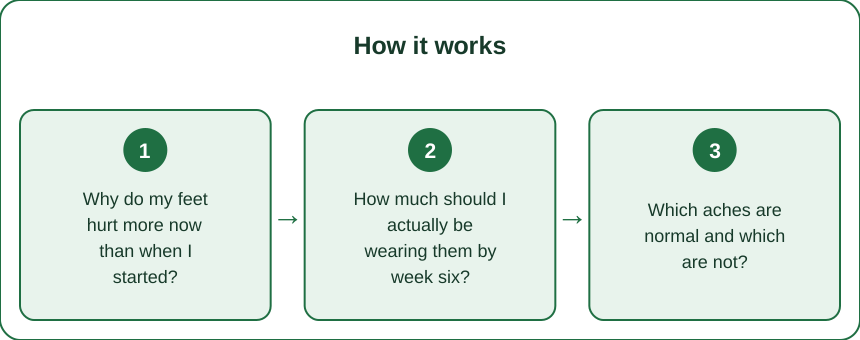
Why do my feet hurt more now than when I started?
Because you are doing more in them than you were.
The honeymoon month is usually low dose. You wear them for errands, a short walk, an hour at a time. Then they become your default shoe, and the daily load quietly triples without you deciding anything.
Meanwhile the tissue timeline has not caught up. Muscle adapts in roughly 4 to 6 weeks. Tendon and fascia take 3 to 6 months, and they are the tissues taking most of the new load in a zero-drop, unsupported shoe. So around week five you are asking half-adapted tissue to do full-time work.
That mismatch is the ache. It is not injury, and it is not a signal the shoes are wrong for your feet. It is the gap between how fast muscle adapts and how fast connective tissue does — and the only real fix is time held at a steady dose.
How much should I actually be wearing them by week six?
Less than you probably are.
A workable progression: start at one hour a day for the first week, then add roughly 30 minutes per week. That puts you at about 3 to 4 hours daily by week six, and full-time somewhere around month three.
Most people compress that into three weeks, hit the wall, and conclude the shoes do not suit them.
If you are already past the sensible ramp and sore, do not reverse to zero. Cut back to about half your current daily hours for ten days, then resume adding 30 minutes weekly from there. Keep one pair of cushioned shoes for the longest standing days — a coffee run in supportive trainers is not a moral failure.
Track hours for two weeks. Almost everyone who does discovers their real number is far higher than their estimate.
Which aches are normal and which are not?
Normal: diffuse arch fatigue that shows up late in the day and fades overnight. Calf tightness, especially in the first month, because a zero-drop shoe lengthens the calf and Achilles more than a heeled one. Slight soreness in the small muscles between the toes.
Worth pausing for: sharp, pinpoint pain under the heel that is worst on the first steps out of bed. Pain over the top of the foot that gets worse with each day rather than better. Any ache that wakes you at night.
The dividing line most people find useful is the morning test. Fatigue improves after a night of rest. An overload injury feels the same or worse on waking.
This is general information, not medical advice — persistent or sharp foot pain is worth a visit to a podiatrist or physio.
Myth vs Fact: The Barefoot Transition
Myth: If they hurt, your feet are too weak and you should push harder. Fact: Pushing through a connective tissue adaptation is the single most reliable way to end up in a boot. Load tolerance rises with consistent moderate dosing, not with heroics.
Myth: Foot strengthening exercises speed the whole thing up. Fact: They help the muscle side, which was never the bottleneck. Toe yoga and short-foot drills are worth 5 minutes a day, but they do not accelerate tendon remodelling.
Myth: The transition is over once the aching stops. Fact: The aching usually stops well before the tissue is fully adapted. That is exactly when people jump to a long hike and set themselves back.
Myth: Wider is always better. Fact: A toe box that is too wide lets the foot slide, which creates its own friction problems. Wide enough to splay, snug enough to stay put.
What changes as the weather turns?
Late summer into autumn is the most common time people abandon the transition, and the reasons are seasonal rather than anatomical.
Cold feet feel stiffer. A foot at 15C has measurably less tissue elasticity than the same foot at 25C. Your week eight walk in September can feel worse than your week four walk in August purely because of temperature.
Thicker socks change the fit. Adding a wool sock to a snug barefoot shoe removes the splay room that made it work. Size for your winter sock, not your summer one.
Surfaces get harder to read. Wet leaves and cold pavement give you less feedback through a thin sole, and people compensate by gripping with their toes — which creates fresh calf and arch fatigue that has nothing to do with the adaptation curve.
Give yourself an extra five minutes of easy walking before anything demanding once mornings drop below about 12C.
FAQ: Month Two Questions, Answered
How long does the full transition really take?
Plan for 6 months to feel genuinely unremarkable in them, with the worst of the discomfort clustered in weeks 4 to 10. Runners should assume longer than walkers.
Should I stop running entirely during the transition?
No, but keep running in your old shoes for now and do the transition on walking mileage first. Running is the highest-load thing your feet do, and it is the last thing to convert.
Can I go back to cushioned shoes without losing progress?
Yes. Alternating is not cheating — it is load management. Most of the adaptation comes from cumulative time in the shoe, not from never taking them off.
TL;DR:
- The month two dip happens because daily hours climbed while tendon and fascia are still remodelling.
- Ramp at about 30 extra minutes per week, not by switching cold turkey.
- Diffuse evening fatigue is normal; sharp first-step heel pain is not.
- Cold weather and thick socks both make week eight feel worse than week four — adjust sizing and warm-up.
If you are in the dip right now, the useful move is boring: hold your current dose, or halve it for ten days, and stop adding. The people who end up loving these shoes are almost never the ones who transitioned fastest. They are the ones who were still wearing them in month four.
Keep Reading
This article is for general informational purposes only and is not medical advice. Always consult a qualified health professional for guidance specific to you.