Barefoot Shoe Calf Soreness: The Real Adaptation Timeline
Quick Answer: Calf soreness in new barefoot shoes is expected, because dropping from a raised heel to a flat sole lengthens the calf’s working range and shifts load onto muscles and tendons that cushioned shoes have been doing the work for. Muscles adapt in weeks; tendons take months. Wear the shoes for short daily doses, expect soreness to peak around days two to three after a longer wear, and treat sharp or one-sided Achilles pain as a stop sign rather than a milestone.
Almost everyone who switches has the same week one: delighted feet, outraged calves. The soreness is not evidence you bought the wrong shoes. It is evidence of how much work your old shoes were quietly doing for you - but the timeline for handing that work back is longer than most people are told.

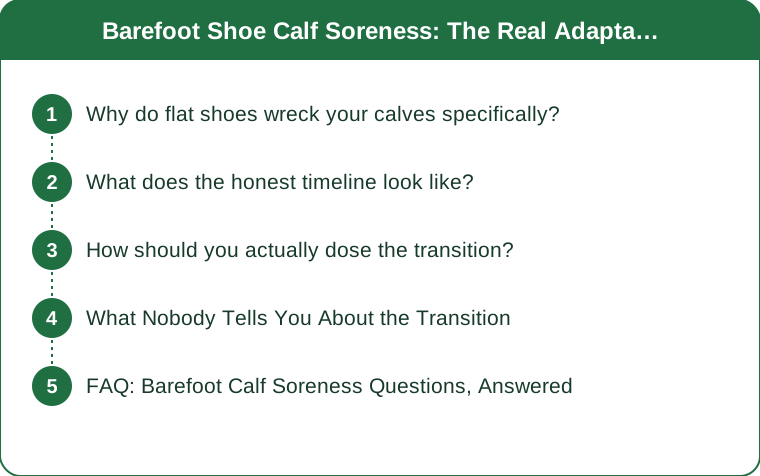
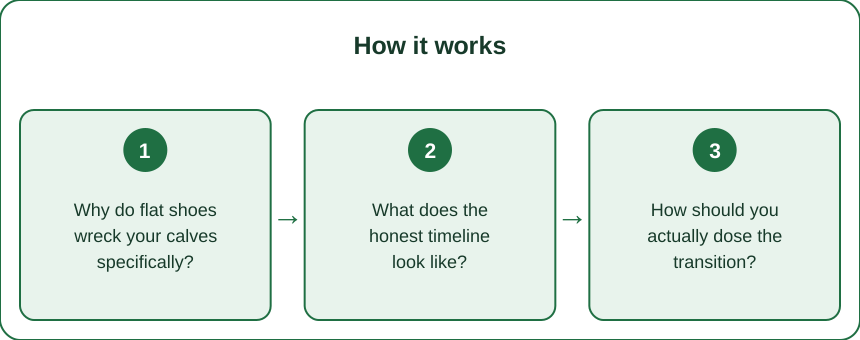
Why do flat shoes wreck your calves specifically?
Most conventional trainers lift your heel 8 to 12mm above your forefoot. That drop shortens the distance your calf and Achilles work through on every single step. Live in raised heels for twenty years and your calves have adapted to that shortened range - efficiently, and completely.
A zero-drop shoe restores the full range on day one. Every step now takes the calf slightly longer, and if the shoe has a thin flexible sole, your foot and lower leg also absorb impact that midsole foam used to handle. Two changes land at once: longer working range and more absorption duty. The calves get both bills.
There is a third factor if you also change how you walk or run. Many people naturally shift from a hard heel strike toward a flatter or forefoot landing in barefoot shoes, and that landing style loads the calf-Achilles system even more. This is why soreness is nearly universal, why it concentrates in the calves and the soles of the feet, and why it is not a sign of damage in itself. It is the standard cost of renovation.
What does the honest timeline look like?
Weeks 1 to 2: Soreness after almost any meaningful wear, typically peaking 24 to 48 hours later - classic delayed-onset soreness. Calves, the arch, sometimes the top of the foot as small muscles wake up. Short wears feel fine; long days do not.
Weeks 3 to 6: Muscle adapts fastest. Everyday walking in the shoes stops producing soreness, and you will be tempted to declare victory. Do not - the muscle is ahead of the tendon.
Months 2 to 4: Tendon and connective tissue adapt on a slower clock, because they remodel through comparatively sluggish processes. This is the window where people who went too fast develop Achilles or forefoot overuse problems, usually right after the week everything finally felt easy.
Months 4 to 12: Running volume, hills, and all-day wear become genuinely comfortable. Feet often spread slightly and get visibly stronger.
The pattern to respect: how you feel today reflects muscle, but your safe workload is set by tendon. Staying a few weeks more conservative than you feel is the entire secret of a clean transition.

How should you actually dose the transition?
Dose by hours and intensity, not vibes.
- Weeks 1 to 2: one to two hours of easy walking per day in the new shoes, ideally split. Old shoes the rest of the day.
- Weeks 3 to 4: half days. Errands, the school run, the office if you are mostly seated.
- Month 2: full days of walking life. If you run, this is where short run intervals start - a few minutes at a time inside a normal run, once or twice a week.
- Months 3 and beyond: build running or long-day volume by around 10 percent a week, backing off any week the Achilles feels thick or stiff in the morning.
Two accelerants help. Calf raises - slow, full range, both bent-knee and straight-knee versions, a few sets most days - prepare the exact tissues under load. And morning stiffness is your gauge: mild general tightness that eases within minutes is normal adaptation; stiffness localised to one Achilles that lingers past the first coffee means repeat last week’s dose instead of progressing.
Late summer is a friendly time to start, incidentally - lighter layers and warmer tissue make easy walking doses pleasant in a way January never is.
What Nobody Tells You About the Transition
The soreness comes back in waves. People expect one hard fortnight and then peace. In reality each new demand - first long walk, first run, first day carrying a heavy bag - triggers a smaller echo of the original soreness. Each wave is shorter. That is the pattern of adaptation working, not failing.
Your feet get louder before they get stronger. You will feel gravel, kerbs, and the exact texture of your kitchen floor. That sensory flood is information your nervous system has been denied for years, and it settles into background awareness within a few weeks.
Old shoes start feeling strange. Somewhere around month two, stepping back into cushioned trainers feels like walking on marshmallows with your heel uphill. This is the clearest sign the adaptation is real.
And the calf soreness has an unexpected upside. The same lengthening that hurts in week one is why many long-term wearers report their ankles feel sturdier and their calves more defined. You have added a working muscle group back into every step you take - thousands of tiny reps a day that cushioning used to absorb.
FAQ: Barefoot Calf Soreness Questions, Answered
How long does calf soreness last with barefoot shoes?
General soreness typically fades within two to six weeks of gradual wear. Expect smaller waves of it for a few months each time you add a new demand like running or all-day wear.
Should I stretch my calves during the transition?
Gentle stretching feels good and is fine, but loaded strengthening - slow calf raises through a full range - does far more for adaptation than stretching alone.
When is calf or heel pain a red flag?
Sharp pain during wear, pain localised to one Achilles, swelling, or morning stiffness that worsens week over week are stop signs. Drop back to your previous dose, and if pain persists or affects normal walking, see a professional. This is general information, not medical advice.
Can I speed up the transition?
You can support it - daily calf raises, gradual dosing, decent sleep - but the tendon timeline does not negotiate. Most transition injuries are simply month-four workloads on month-one tissue.
TL;DR:
- Dropping the heel lengthens the calf’s working range - soreness is the standard cost, not a defect.
- Muscle adapts in weeks; tendons take months. Your safe workload is set by the slower clock.
- Dose in hours per day, progress roughly weekly, and let morning Achilles stiffness veto any increase.
- Slow loaded calf raises accelerate the process more than any stretch.
The transition rewards patience so predictably that the outcome is almost boring: dose it gradually and you get strong, quiet feet; rush it and you meet the one tendon timeline everyone was warned about.
Keep Reading
This article is for general informational purposes only and is not medical advice. Always consult a qualified health professional for guidance specific to you.