Are Barefoot Shoes Actually Better for Lifting? What Changes and What Doesn't
Quick Answer: For deadlifts, hip hinges, and most machine work, a flat wide shoe is genuinely better than a cushioned running shoe - it shortens the bar path, improves floor feedback, and stops your foot rolling on a compressible sole. For deep squats with limited ankle mobility, a raised heel often lets you squat better than zero-drop does. Barefoot shoes are a real upgrade for most gym work and a lateral move for some of it.
If you’re currently lifting in running shoes, almost any change is an improvement. The interesting question is which change.

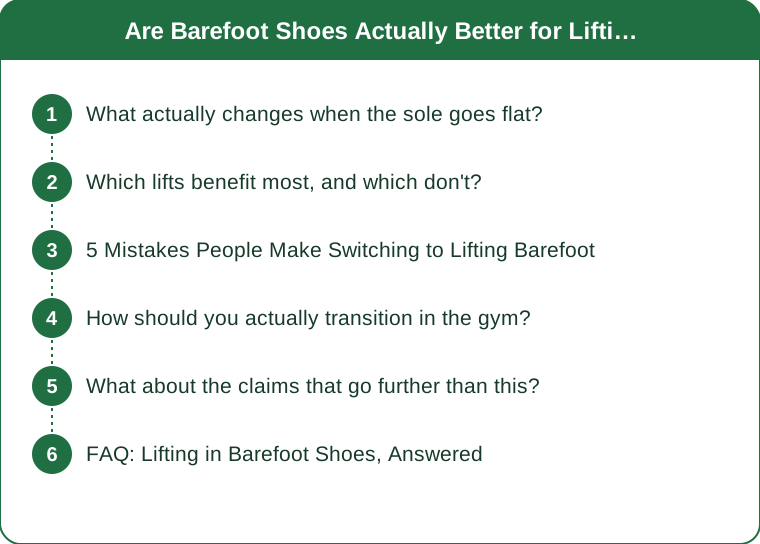
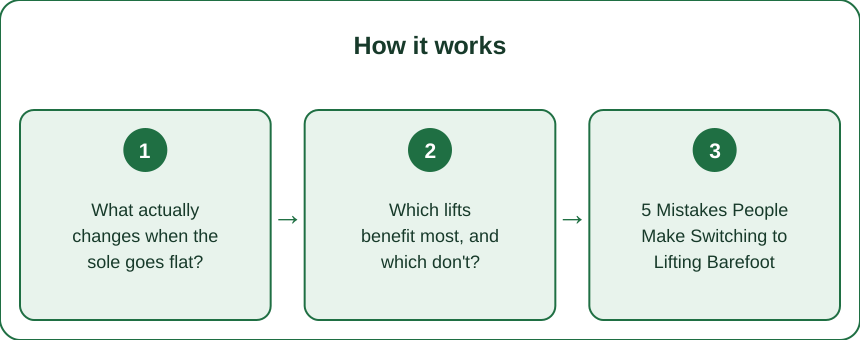
What actually changes when the sole goes flat?
Three things, all mechanical rather than mystical.
1. The sole stops compressing. A cushioned running midsole is designed to deform under load - that’s its entire purpose. Under a heavy squat or a loaded carry, that deformation happens unevenly, and your foot rolls slightly on a surface that is moving underneath it. Lifting on a compressible foam midsole is closest to lifting on a very firm mattress. A flat, firm sole removes that variable.
2. Your foot spreads. Barefoot-style shoes have a wide toe box, which lets the toes splay under load. Toe splay increases the effective surface area you’re balancing on, and it’s the mechanism behind the ‘gripping the floor’ cue that lifting coaches use.
3. Floor feedback increases. A thin sole transmits more information about where your weight actually is. This matters most in single-leg work and in the setup phase of heavy lifts, where small weight-distribution errors compound.
What doesn’t change: how strong you are, whether your technique is sound, and whether your programme is any good. Shoes are a small variable that’s easy to control, which is exactly why they get discussed more than their effect size warrants.
Which lifts benefit most, and which don’t?
The split is fairly clean, and it comes down to ankle demand.
Clear benefit - deadlifts and hinges. A zero-drop sole with minimal stack means the bar starts closer to the floor, which shortens the distance it travels. It also puts you flat-footed with weight through the mid-foot, which is where a deadlift setup wants it. This is the least controversial application in the whole discussion.
Clear benefit - loaded carries, step-ups, lunges, and single-leg work. Anything where balance and foot stability matter benefits from a firm base and a wide toe box.
Clear benefit - hip thrusts, glute bridges, and most machine work. Stability without compression, and nothing here demands ankle range.
Mixed - back squats and front squats. This depends entirely on your ankle mobility. Deep squatting requires substantial ankle dorsiflexion, and a raised heel effectively borrows range you don’t have. That’s the whole reason weightlifting shoes have a raised heel. If you can already squat to depth flat-footed with an upright torso, zero-drop is fine and arguably better. If you can’t, a heel lift will let you squat better today while you work on the mobility.
Not the right tool - plyometrics and jumping. Repeated landings without cushioning is a load your feet need to be conditioned for. This is worth building toward, not starting with.
5 Mistakes People Make Switching to Lifting Barefoot
Mistake 1: Switching on a heavy day. Your setup, balance, and bar path all shift slightly in a new shoe. Doing that under a near-maximal load is how a technique adjustment becomes a bad rep. Switch on a deload or a technique day.
Mistake 2: Assuming gym use means you’ve transitioned. Lifting in barefoot shoes loads your feet very differently from walking or running in them. Being comfortable squatting flat says almost nothing about whether your feet are ready for a 5k in the same shoe.
Mistake 3: Blaming the shoes for a mobility problem. If your heels lift during a squat in zero-drop shoes, the shoes revealed something rather than caused it. Use a heel lift so you can keep training productively, and work on ankle dorsiflexion separately - calf stretching and loaded ankle mobility work, most days.
Mistake 4: Going straight to fully barefoot on a gym floor. Aside from hygiene, most commercial gyms prohibit it, and dropping anything on an unprotected foot is a bad afternoon. A minimal shoe gets you nearly all the benefit with a toe cap.
Mistake 5: Buying a ‘barefoot’ shoe that isn’t. Marketing has spread the term wide. The three specifications that actually matter are zero drop from heel to toe, a genuinely wide toe box, and a thin flexible sole - a shoe missing any of those isn’t providing the effect you’re paying for.

How should you actually transition in the gym?
Faster than for running, but not immediately.
Weeks 1-2: upper body and machines only. Wear them for pressing, rows, machine work, and anything seated. Your feet are still adapting to a flat, unsupported position under load, and this gets them used to it at low stakes.
Weeks 2-4: add deadlifts and hip hinges. These are the highest-benefit and lowest-risk lifts for the switch. Expect the setup to feel slightly different and your first few sets to feel odd - that’s the shortened range and the new foot position, not a problem.
Weeks 4-6: add squats at reduced load. Drop about 20% and pay attention to whether your heels stay down and your torso stays as upright as usual. If they don’t, this is your mobility signal.
Weeks 6+: single-leg work and carries. These demand the most from foot stability, so they’re last.
Expect some calf and arch soreness in the first two to three weeks. The intrinsic foot muscles and the calf complex are doing work a supportive shoe was previously doing, and mild soreness is a normal adaptation. Sharp arch pain, heel pain that’s worst on the first steps in the morning, or pain that persists past a few weeks is different and warrants slowing down and getting advice. This is general information, not medical advice.
Keep both pairs. There’s no rule saying one shoe covers everything - a raised-heel shoe for squats and a flat one for pulls is a completely reasonable setup that a lot of experienced lifters use.
What about the claims that go further than this?
Worth separating what’s mechanically obvious from what’s genuinely uncertain.
Well supported and non-controversial: a firm, incompressible sole is more stable under load than a compressible one. This isn’t really a barefoot-shoe claim so much as a basic observation about foam.
Reasonable and mechanically sound: zero drop shortens deadlift range, a wide toe box allows toe splay, and thin soles increase floor feedback. These follow directly from the geometry.
Plausible but oversold: that minimal footwear strengthens the foot’s intrinsic muscles. There’s supportive research here, and the mechanism makes sense - a muscle that has to work will adapt. But the effect is gradual, individual, and much smaller than the marketing suggests, and it’s not a substitute for actual foot strengthening exercises.
Not supported: that minimal shoes prevent injuries generally, fix knee or back pain, or improve running economy across the board. The evidence on injury outcomes is genuinely mixed, and the transition period itself carries a well-documented risk of bone stress injuries when rushed.
The honest summary: for gym work specifically, this is a small, real, low-risk improvement in stability and mechanics. That’s a good thing and worth doing. It’s just not a training intervention on the scale of adding a training day or fixing your programme.
FAQ: Lifting in Barefoot Shoes, Answered
Can I just lift in socks instead?
Many people do, and it works mechanically. Most commercial gyms prohibit it for hygiene and safety, and socks on rubber flooring can be slippery in a way bare feet aren’t.
Are barefoot shoes okay for CrossFit-style workouts?
Mixed. They’re good for the lifting portions and less good for the jumping and running portions. Many people keep a flat shoe for lifting days and a cushioned one for conditioning.
Do I need a special shoe for deadlifting or is any flat shoe fine?
Any flat, firm, thin-soled shoe covers most of the benefit - flat canvas shoes have been a budget standard for decades. The wide toe box is the additional thing barefoot shoes offer.
My heels lift in squats now. Is that the shoes’ fault?
The shoes revealed an existing ankle mobility limitation rather than creating it. Use a heel lift or a raised-heel shoe to keep training well, and address dorsiflexion separately.
TL;DR:
- Flat, firm soles beat compressible foam for anything loaded - that part isn’t controversial
- Deadlifts, hinges, carries, and single-leg work benefit most
- Deep squats with limited ankle mobility often go better with a raised heel, not zero drop
- Transition over six weeks: machines, then pulls, then squats, then single-leg
- Keeping two pairs for different lifts is a completely normal setup
Good shoes won’t build your squat. Bad ones can quietly cap it.
Keep Reading
This article is for general informational purposes only and is not medical advice. Always consult a qualified health professional for guidance specific to you.