Barefoot Shoes on Concrete: Why City Walking Is the Hardest Test
Quick Answer: Concrete is the hardest surface most people ever walk on and returns almost no energy, which means your foot’s own tissues absorb everything. If you’re transitioning to barefoot shoes in a city, cut your initial exposure to roughly half what trail-based guides recommend - start at 15 to 20 minutes of concrete walking, add no more than 10 percent per week, and shorten your stride before you do anything else.
The transition guides are written by people who run on trails. Dirt compresses, grass gives, and a woodland path varies your foot placement with every step. A sidewalk does none of that, and it does none of it for eight thousand steps a day.
If your minimal shoes felt fine on a weekend walk and miserable on a Tuesday commute, the shoes aren’t the problem and neither are your feet. The surface is doing something different.

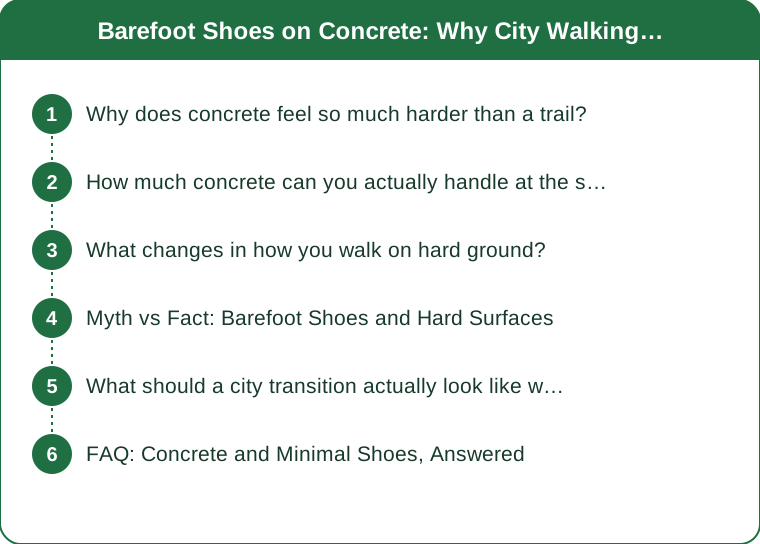
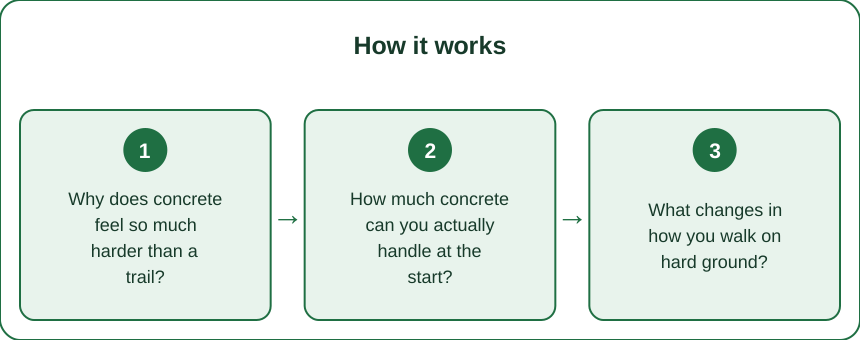
Why does concrete feel so much harder than a trail?
Because it is, and because it never varies.
Concrete has essentially zero compliance. When your foot strikes soft ground, the ground deforms and absorbs part of the impact. Concrete deforms by an immeasurably small amount, so every bit of that energy goes back into your foot, ankle, and shin. In a cushioned shoe, the midsole does the deforming instead. Take the midsole away and the tissue does it.
Uniformity is the other half, and it’s the half nobody mentions. A trail places your foot at a slightly different angle every single step, which distributes load across different tissues and gives each one micro-recovery. A sidewalk loads the identical structures in the identical way eight thousand times. Repetitive identical loading is how tissue gets overloaded - not from any single hard step, but from the absence of variation.
The practical consequence: your calves and the plantar fascia are the two tissues that complain first on concrete, and they complain in a different pattern than they do on trails. Trail soreness tends to be diffuse and across the whole foot. Concrete soreness tends to be specific and repetitive - the same spot, same intensity, every day.
This is general information, not medical advice. Sharp heel pain that’s worst on your first steps in the morning, or shin pain that persists at rest, is worth having assessed rather than walking through.
How much concrete can you actually handle at the start?
Considerably less than the standard advice suggests, and the standard advice is already conservative.
A workable concrete-specific progression:
- Week 1: 15 minutes of continuous concrete walking, three days, non-consecutive
- Week 2: 20 minutes, three days
- Week 3: 25 minutes, four days
- Week 4: 30 minutes, four days
- From then: add no more than 10 percent per week, and hold at any week where soreness carries over to the next day
The critical detail people miss: this is total barefoot-shoe time on hard surfaces, not workout time. Wearing minimal shoes to the office and walking to the coffee machine forty times counts. The commute counts. The reason so many transitions fail in week three is that the person counted the deliberate walk and ignored the six thousand incidental steps.
Wear a second pair. The single most effective strategy for a city transition is to carry conventional shoes and change into them once you hit your daily minimal allowance. It feels absurd for about a week and then it’s just what you do.
The signal to hold, not push: morning stiffness on the underside of the foot that lasts more than a few steps. That’s the plantar fascia telling you it’s still adapting, and it’s the single most reliable early warning available.
What changes in how you walk on hard ground?
Three adjustments, and the first one does most of the work.
Shorten your stride. This is the whole ball game. A long stride requires a heel-first landing with the leg extended in front of the body, which sends impact straight up the skeleton with no muscular absorption. Shortening your stride by roughly 10 percent and increasing your cadence to compensate puts your foot down closer to underneath you, where the ankle and calf can absorb the load. Most people can feel the difference within one block.
Land quieter. Not a technique so much as a feedback signal. Listen to your own footfalls - a slapping sound means you’re landing with a stiff ankle and letting the foot drop. Aim to make the walk quiet, and your ankle mechanics will sort themselves out without you consciously changing anything.
Stop pushing off so hard. In cushioned shoes there’s a spring to push against. On concrete in minimal shoes, an aggressive toe-off loads the forefoot and the calf far more than a rolling, relaxed one. Walk as though the ground is slightly slippery and you’ll naturally moderate it.
What not to do: deliberately forefoot-strike while walking. Forefoot striking is a running adaptation, and forcing it during walking is a very reliable route to calf strain. Walking with a light heel contact and a short stride is completely normal in minimal shoes.

Myth vs Fact: Barefoot Shoes and Hard Surfaces
Myth: Humans evolved to walk barefoot, so concrete should be fine. Fact: Humans evolved on savanna, forest floor, and sand - surfaces that compress and vary. Continuous flat concrete is roughly 200 years old at scale. The foot is adaptable, but the surface is genuinely novel, and treating it as the default our feet were designed for skips the adaptation entirely.
Myth: If it hurts, your feet are just weak and you should push through. Fact: Tissue adapts to load, but bone and fascia adapt considerably slower than muscle. Muscle strength can improve in weeks; bone remodelling takes months. Pushing through pain in a barefoot transition is how people acquire metatarsal stress reactions - the classic injury of transitioning too fast.
Myth: A thicker minimal shoe is cheating. Fact: A 8mm zero-drop sole with no arch support is still fully minimal in every way that matters - no heel lift, no motion control, wide toe box, flexible. Stack height is the one variable you can add on concrete without losing the actual benefits.
Myth: You should feel every pebble. Fact: Ground feel is a means, not a goal. On a trail it gives useful information. On uniform concrete there’s no information to receive, so all the extra sensation buys you is discomfort.
Myth: Once transitioned, you can wear them for everything. Fact: Plenty of long-term minimal-shoe wearers still switch for a full day on concrete at a trade show or a museum. Standing still on concrete is a different and arguably harder load than walking on it.
What should a city transition actually look like week to week?
A concrete plan, in the literal sense.
Weeks 1-2: exposure only, no distance goals
Wear them for short local errands and around the house. Do calf raises, 2 sets of 15, daily - the calf complex is what’s about to take the load, and it responds fast. Add toe spreading and short-foot exercises, 2 minutes a day.
Weeks 3-6: replace one commute leg
Walk to the station in minimal shoes, change at the office. This gives you a fixed, repeatable dose you can’t accidentally exceed. Hold at any week where you have next-morning stiffness.
Weeks 7-12: both legs of the commute, still with a change of shoes at the desk
Standing all day on concrete in minimal shoes is a separate adaptation from walking, and it’s worth deferring.
Months 4-6: standing time, gradually
Add an hour at a time. This is the phase people skip and it’s the one that determines whether minimal shoes work for your actual life.
Throughout: keep one non-concrete session a week. A park, a grass verge, a beach if you have one. The variation is genuinely restorative, and it’s the closest thing to what the foot is actually adapted to. Twenty minutes on grass barefoot does more for foot resilience than an extra mile of pavement.
FAQ: Concrete and Minimal Shoes, Answered
How long does the whole transition take on city surfaces?
Longer than the six to eight weeks often quoted - plan on four to six months to be walking a full day comfortably, and up to a year before standing all day feels normal. Bone and fascia set that timeline, not motivation.
Are insoles a betrayal of the concept?
No. A thin flat insole with no arch support adds a little cushioning without changing foot mechanics at all. What matters is zero drop, a wide toe box, and flexibility - not the absence of all material.
Why do my calves hurt more than my feet?
Because a zero-drop shoe lengthens the calf and Achilles compared with a shoe with a raised heel, and the calf takes on more shock absorption. Calf soreness in the first weeks is expected. Achilles pain specifically - localised, at the tendon - is a reason to back off rather than push.
Is it worth it in a city at all?
Many people find yes, for toe splay, foot strength, and comfort. But the honest answer is that the benefit-to-hassle ratio is lower on concrete than on varied ground, and there’s nothing wrong with wearing minimal shoes for walks and gym work while wearing something cushioned for eight hours on a hard floor.
TL;DR:
- Concrete has near-zero compliance and never varies, so the same tissue takes identical load thousands of times
- Halve standard transition volumes: start at 15-20 minutes, add 10 percent weekly
- Count incidental steps, not just deliberate walks - this is why most transitions fail in week three
- Shorten your stride and listen for quiet footfalls; don’t force a forefoot strike while walking
- Carry a second pair and change once you hit your daily allowance
- Plan on four to six months, and keep one session a week on grass or varied ground
The feet aren’t the weak link. The surface is unusually unforgiving, and pacing for it is the whole difference between a transition that sticks and one that ends in week three.
Keep Reading
This article is for general informational purposes only and is not medical advice. Always consult a qualified health professional for guidance specific to you.