Why Late Summer Is the Best Time to Start Barefoot Shoes
Quick Answer: Warm weather makes the barefoot transition easier through three mechanisms: warm feet are more pliable and adapt more comfortably to a new movement pattern, varied natural surfaces are accessible for barefoot walking that builds foot strength faster than shoes alone, and thin summer socks let you feel ground texture properly. Starting now gives you 8-10 weeks of favourable conditions before autumn.
Most people buy barefoot shoes in autumn when they’re thinking about new routines, and then struggle through a transition in cold weather on hard urban surfaces. The conditions right now are considerably better, and the reasons are specific.

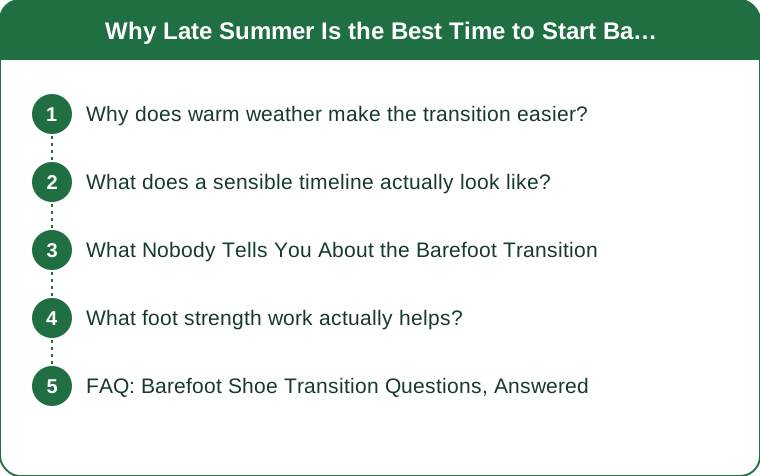
Why does warm weather make the transition easier?
Warm tissue is more compliant. Tendons, ligaments, and plantar fascia are all more pliable at higher temperatures, which means the increased range of motion a barefoot shoe demands is available more readily. Cold feet are stiffer feet, and a stiff foot being asked to move in a new way is where a lot of early-transition discomfort comes from.
This is the same reason morning stiffness is worse than afternoon stiffness for most people with foot complaints - and starting a transition in cold weather stacks that against you.
Circulation is better in warm conditions, which supports recovery in the small muscles of the foot that are doing genuinely new work during a transition.
You can access varied natural surfaces. Grass, sand, and dirt paths are all available now in a way they aren’t in November. Walking barefoot on varied natural surfaces is one of the more effective ways to build intrinsic foot strength, and it’s free.
Thin socks or no socks improve proprioceptive feedback. Part of the point of a barefoot shoe is ground feel, and a thick winter sock substantially dulls it. Learning the movement pattern with good feedback and then adding socks later is easier than the reverse.
What does a sensible timeline actually look like?
The most common transition mistake is doing too much too soon, and it’s worth being specific about pacing.
Weeks 1-2: barefoot at home, shoes for short walks. Spend time barefoot indoors - this alone is a meaningful stimulus for feet that have been in supportive shoes for years. Wear the barefoot shoes for 30-60 minutes of walking a day, no more.
Weeks 3-4: extend walking, add grass. Build to 90 minutes of walking in the shoes. Add 10-15 minutes of barefoot walking on grass or sand 2-3 times a week. Grass is forgiving and varied - ideal early surface.
Weeks 5-8: most daily walking, add foot strength work. By now most people can wear them for a normal day of walking. Add specific foot exercises: toe spreading, short foot exercise, calf raises, and single-leg balance.
Weeks 9-12: consider running, if that’s the goal. Running in barefoot shoes is a separate transition and should start at very low volume - many coaches suggest beginning with a few hundred metres, not a few kilometres.
The calf soreness question: significant calf and Achilles soreness in the first 2-4 weeks is extremely common, because a zero-drop shoe puts more load on the calf complex. Soreness that eases within 48 hours is expected. Pain that’s sharp, localised at the Achilles, or worsening is not - that’s a stop-and-assess signal. This is general information, not medical advice.

What Nobody Tells You About the Barefoot Transition
Your shoe size might change. Feet that spread naturally without a narrow toe box often need a wider size after several months. Buying an entire barefoot wardrobe in month one is a common expensive mistake.
The adaptation is muscular, not just habitual. The intrinsic foot muscles have often been substantially underused for decades. Building them is a strength adaptation on a strength timeline - months, not weeks - and no amount of enthusiasm compresses it.
Hard urban surfaces are harder than natural ones. Concrete is uniformly hard and unvarying, which is more demanding than a natural surface that varies. If your walking is all pavement, progress more slowly than these timelines suggest.
Your gait will change on its own, and shouldn’t be forced. Deliberately trying to land differently often produces a worse pattern than letting the shoe’s feedback shape it gradually. The shoe is the coach; conscious overriding usually isn’t helpful.
Not everyone should transition. People with certain foot conditions, diabetes with any degree of neuropathy, or significant structural issues should get professional input first. The barefoot community is enthusiastic and sometimes underplays this. This is general information, not medical advice.
The transition can stall and that’s normal. Plateaus of several weeks where nothing improves are common and usually resolve with patience rather than with more volume.
What foot strength work actually helps?
These are the exercises with the clearest rationale, and they take about eight minutes.
Short foot exercise. Sitting, foot flat, draw the ball of your foot toward the heel without curling the toes - creating a small arch lift. Hold 5 seconds, 10 reps per foot. This targets the intrinsic muscles directly and is the most specific exercise available.
Toe spreading. Actively spread your toes apart and hold. Harder than it sounds, and most people can barely do it initially. 10 reps per foot.
Toe yoga. Lift the big toe while keeping the others down, then reverse. This trains independent toe control, which is genuinely useful for balance and largely absent in people who’ve worn narrow shoes for years.
Calf raises, including eccentric. Rise onto the balls of your feet and lower slowly over 3 seconds. 15 reps. Directly supports the calf and Achilles that take extra load in a zero-drop shoe.
Single-leg balance, barefoot, on varied surfaces. 30 seconds per side, on a firm floor first, then on grass or a cushion. Trains proprioception, which is part of what barefoot shoes are meant to restore.
Frequency: daily is fine and better than three times a week - these are low-load and respond to frequency.
Toe spacers are worth mentioning: many people find them useful for encouraging natural toe splay, typically worn for short periods initially rather than all day.
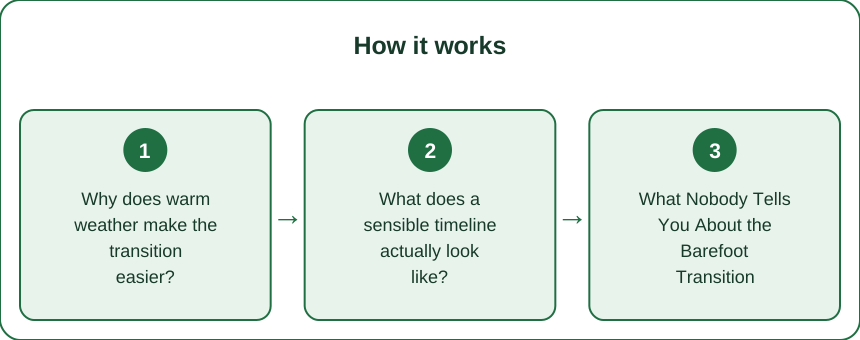
FAQ: Barefoot Shoe Transition Questions, Answered
How long does the full transition take?
Walking comfortably in them: commonly 8-12 weeks. Full adaptation of foot strength and running capacity: often 6-12 months. Slower than most people expect.
Is calf soreness normal or a warning sign?
General calf soreness that eases within 48 hours is expected. Sharp, localised Achilles pain, pain that’s worse in the morning, or soreness that worsens week over week warrant assessment.
Can I switch back and forth between barefoot and regular shoes?
Yes, and many people do indefinitely. Alternating during the transition is a reasonable way to manage load rather than a failure.
Do I need to start in summer specifically?
No - people transition successfully year-round. Warm weather and access to natural surfaces just make it easier, which is worth taking advantage of if the timing works.
What about starting with running instead of walking?
Not advisable. Walking builds the base that running loads. Running is a separate later transition with its own low starting volume.
TL;DR:
- Warm tissue is more compliant, circulation is better, and natural surfaces are accessible - all favourable for a transition
- Weeks 1-2: barefoot at home plus 30-60 min in the shoes. Build to full days by weeks 5-8
- Calf soreness in the first weeks is expected; sharp or worsening Achilles pain is not
- Eight minutes of daily foot work - short foot, toe spreading, toe yoga, calf raises, balance - accelerates it meaningfully
- Don’t buy a full barefoot shoe wardrobe in month one; your size may change
This is general information, not medical advice - get professional input first if you have diabetes, neuropathy, or a known foot condition.
Keep Reading
This article is for general informational purposes only and is not medical advice. Always consult a qualified health professional for guidance specific to you.