What to Expect During a Barefoot Shoe Transition, Week by Week
Quick Answer: Most guidance recommends transitioning to barefoot shoes gradually over 8-12 weeks, not switching all at once — the calves and small stabilizing muscles in the feet need time to adapt to a workload traditional cushioned shoes had been absorbing for years.
The most common barefoot shoe injury isn’t from the shoes themselves — it’s from transitioning too fast into them.

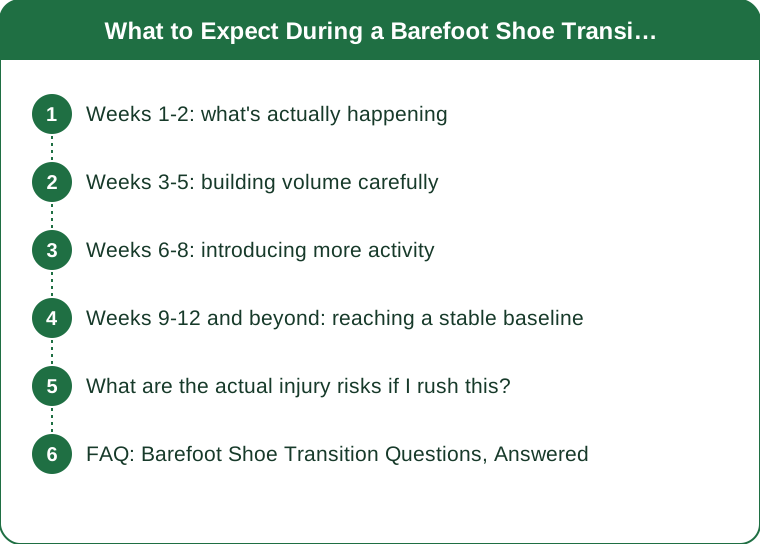
Weeks 1-2: what’s actually happening
Early on, you’re mostly building basic tolerance — short walks (15-20 minutes) in the new shoes, noticing calf and foot fatigue that wouldn’t have shown up in traditional cushioned shoes.
This fatigue is expected and is a sign the smaller stabilizing muscles in the feet, often underused in cushioned shoes, are starting to engage — it’s not itself a red flag.
Weeks 3-5: building volume carefully
This is typically when people gradually extend wear time and start reintroducing some of their normal daily walking in the shoes, though most guidance still recommends keeping any actual running minimal or absent at this stage.
Calf soreness in this window is common and generally considered a normal adaptation response — sharp or joint-specific pain, on the other hand, is not something to push through.
Weeks 6-8: introducing more activity
By this stage, many people begin light jogging or more demanding activity in barefoot shoes, still keeping volume conservative relative to what they’d do in traditional shoes at the same point.
A common guideline: increase mileage or wear time by no more than about 10% per week during this phase, which mirrors general injury-prevention advice for any new training load.

Weeks 9-12 and beyond: reaching a stable baseline
Most sources suggest that by around 8-12 weeks of consistent, gradual use, feet and calves have adapted enough for regular full-day wear and normal activity levels in barefoot shoes, assuming no injury interrupted the process.
Some people take longer, and that’s normal — prior shoe history (years in highly cushioned shoes generally mean a longer adaptation period) and activity level both affect the timeline.
What are the actual injury risks if I rush this?
Stress fractures, particularly in the metatarsal bones of the foot, are the most cited risk of transitioning too quickly, along with Achilles tendon strain from the increased calf demand barefoot shoes place on that tendon.
Both are linked in podiatric literature primarily to rushing volume, not to barefoot shoes themselves being inherently risky when transitioned properly.
FAQ: Barefoot Shoe Transition Questions, Answered
Can I speed up the transition if my feet feel fine early on?
Generally not recommended — feeling fine in week 2 doesn’t mean the deeper structural adaptation (bone density changes, tendon strengthening) has caught up, even if it doesn’t hurt yet.
Should I do foot-strengthening exercises alongside wearing the shoes?
Yes — many podiatrists and barefoot shoe transition guides recommend calf raises, toe splays, and short foot exercises alongside gradual shoe wear to speed adaptation safely.
Is barefoot shoe transition harder for people who’ve run for years in cushioned shoes?
Often yes — a longer history in heavily cushioned shoes generally means a longer, more conservative transition timeline is warranted.
TL;DR:
- Most transitions take 8-12 weeks of gradual, consistent wear, not an immediate switch
- Calf and foot fatigue in the first weeks is normal adaptation; sharp or joint pain is not
- Increase mileage or wear time by roughly 10% per week during the more active phase
- Rushing the transition is linked to stress fractures and Achilles strain, not the shoes themselves
This is general information, not medical advice — a podiatrist can help pace a transition for existing foot conditions.
Keep Reading
This article is for general informational purposes only and is not medical advice. Always consult a qualified health professional for guidance specific to you.