5 Signs You're Transitioning to Barefoot Shoes Too Fast
Quick Answer: Sharp or localized pain (versus general new-muscle soreness), symptoms that worsen rather than plateau week over week, and skipping the recommended gradual mileage increase are the clearest signs the transition is happening faster than your feet’s connective tissue can adapt.
Barefoot shoes feel great immediately for a lot of people, which is exactly what makes overdoing the transition so easy — the shoe feels fine even when the underlying tissue adaptation hasn’t caught up yet.

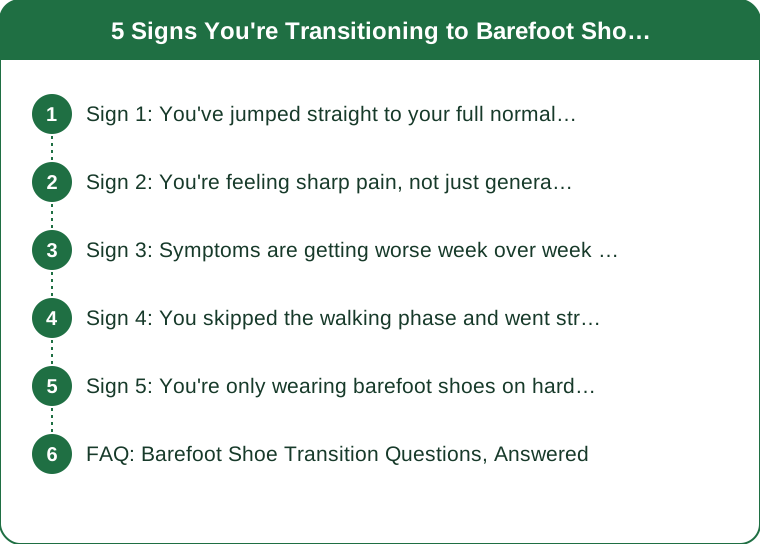
Sign 1: You’ve jumped straight to your full normal walking or running volume
Barefoot shoe transitions typically need weeks to months of gradually increasing time, since foot and lower leg connective tissue adapts more slowly than the shoe itself feels comfortable. Wearing barefoot shoes for your normal full-length run or full workday in week one is a common and risky shortcut.
Sign 2: You’re feeling sharp pain, not just general new-muscle soreness
Mild, generalized soreness in the arch or calf — similar to starting any new exercise — is a normal adaptation response. Sharp, localized pain, especially in the arch or along the shin, is a different signal and means the transition pace needs to slow down, not push through.
Sign 3: Symptoms are getting worse week over week instead of easing
A normal adaptation curve involves some soreness that plateaus or improves as tissue strengthens over 2-3 weeks. Symptoms that are progressively worsening rather than stabilizing indicate the current pace is outrunning your body’s actual adaptation rate.

Sign 4: You skipped the walking phase and went straight to running or high-impact activity
Most gradual transition guides recommend weeks of walking-only barefoot shoe use before introducing running or higher-impact activity — skipping straight to running significantly increases the load your foot’s connective tissue has to adapt to all at once.
Sign 5: You’re only wearing barefoot shoes on hard, flat surfaces without variety
Counterintuitively, exclusively flat, hard surfaces (like treadmills or sidewalks) can concentrate repetitive stress in the same tissue patterns. Some natural surface variety (grass, trails) during a transition, where appropriate, can distribute load differently and may ease adaptation.
FAQ: Barefoot Shoe Transition Questions, Answered
How long should a barefoot shoe transition actually take?
Most guidance suggests 2-3 months of gradual mileage and time increase for a full transition, though this varies by individual foot strength and prior footwear history.
Is some soreness during the transition expected?
Yes — mild, generalized soreness that plateaus and improves is a normal part of tissue adaptation, distinct from sharp or worsening pain.
When should barefoot shoe transition pain prompt seeing a professional?
Sharp pain that doesn’t improve within a week of reduced use, or any pain that worsens progressively, warrants a podiatrist or physical therapist evaluation rather than continued self-managed pacing. This is general information, not medical advice.
TL;DR:
- Jumping to full volume in week one is the most common overdoing-it mistake
- Sharp, localized pain differs from normal new-muscle soreness — treat it differently
- Worsening symptoms week over week means slow down, not push through
- Walking-only phase before running protects tissue still adapting to load. This is general information, not medical advice.
Keep Reading
This article is for general informational purposes only and is not medical advice. Always consult a qualified health professional for guidance specific to you.