Why Your Calves Are So Sore After Switching to Barefoot Shoes (And What to Do)
Quick Answer: Zero-drop barefoot shoes remove the elevated heel your calves have adapted to over years, forcing them to work harder with every step — soreness in the first 2-4 weeks is expected, but it should decrease weekly, not stay flat or worsen.
Traditional shoes with an elevated heel let your calves relax slightly with every step. Barefoot shoes remove that assist entirely, which is exactly why the transition period involves real, noticeable calf soreness for most people.

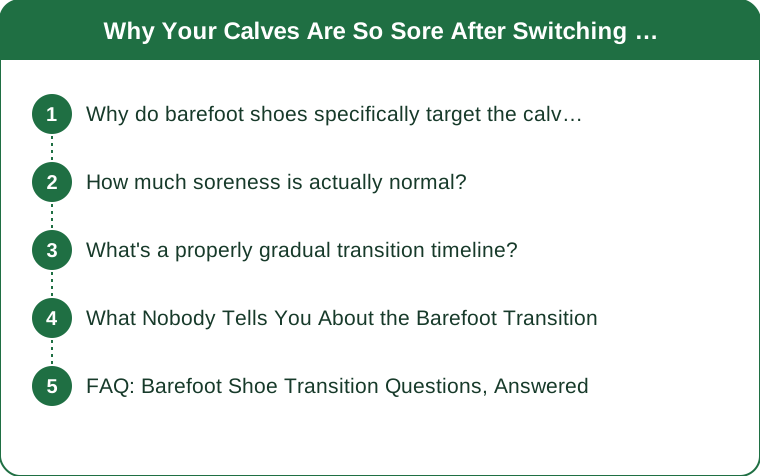
Why do barefoot shoes specifically target the calves?
Most conventional shoes have a 8-12mm heel-to-toe drop that shifts some of your body weight forward through a pre-built ramp. Zero-drop barefoot shoes remove that ramp, meaning your calf and Achilles tendon do more direct work stabilizing each step — work your calves haven’t had to do in years if you’ve worn elevated-heel shoes consistently.
How much soreness is actually normal?
Mild to moderate soreness, similar to starting any new lower-leg exercise, for the first 2-4 weeks of a properly gradual transition. The soreness should measurably decrease week over week — flat or worsening soreness past week 3-4 usually means the transition pace is too fast, not that something is fundamentally wrong.

What’s a properly gradual transition timeline?
Week 1-2: wear barefoot shoes for short periods (1-2 hours), mixed with regular shoes the rest of the day. Week 3-4: extend to half days. Week 5-8: full-time wear for walking, delaying any running transition until walking feels fully comfortable. Rushing this — going full-time in week 1 — is the single most common cause of excessive soreness or injury.
What Nobody Tells You About the Barefoot Transition
Nobody mentions that calf soreness often peaks around day 3-5 of a new activity level, not immediately — so day-one comfort doesn’t predict day-four soreness. Nobody mentions that daily calf stretching and self-massage measurably speeds recovery between wear sessions during the transition period. And almost nobody mentions that some people need 3-4 months, not the commonly cited 4-6 weeks, for a full comfortable transition — timeline varies significantly with starting calf flexibility and activity level.
FAQ: Barefoot Shoe Transition Questions, Answered
How long should the barefoot shoe transition period last?
Most gradual transition plans run 4-8 weeks for walking, with full-time comfort sometimes taking 3-4 months for some individuals — patience matters more than speed here.
Should I stop wearing barefoot shoes if my calves are sore?
Mild, gradually decreasing soreness is expected and doesn’t require stopping. Sharp pain, swelling, or soreness that’s getting worse rather than better is a sign to slow the transition pace or consult a professional.
Does stretching help with barefoot shoe transition soreness?
Daily calf stretching and gentle self-massage are commonly recommended to ease transition soreness, though the primary fix is simply a slower, more gradual increase in wear time. This is general information, not medical advice.
TL;DR:
- Zero-drop shoes remove the elevated heel your calves have relied on for years
- Mild, gradually decreasing soreness for 2-4 weeks is normal and expected
- Flat or worsening soreness past week 3-4 usually means the transition is too fast
- Full transitions can realistically take 3-4 months, not just a few weeks
This is general information, not medical advice — slow the pace if soreness isn’t improving week over week.
Keep Reading
This article is for general informational purposes only and is not medical advice. Always consult a qualified health professional for guidance specific to you.